
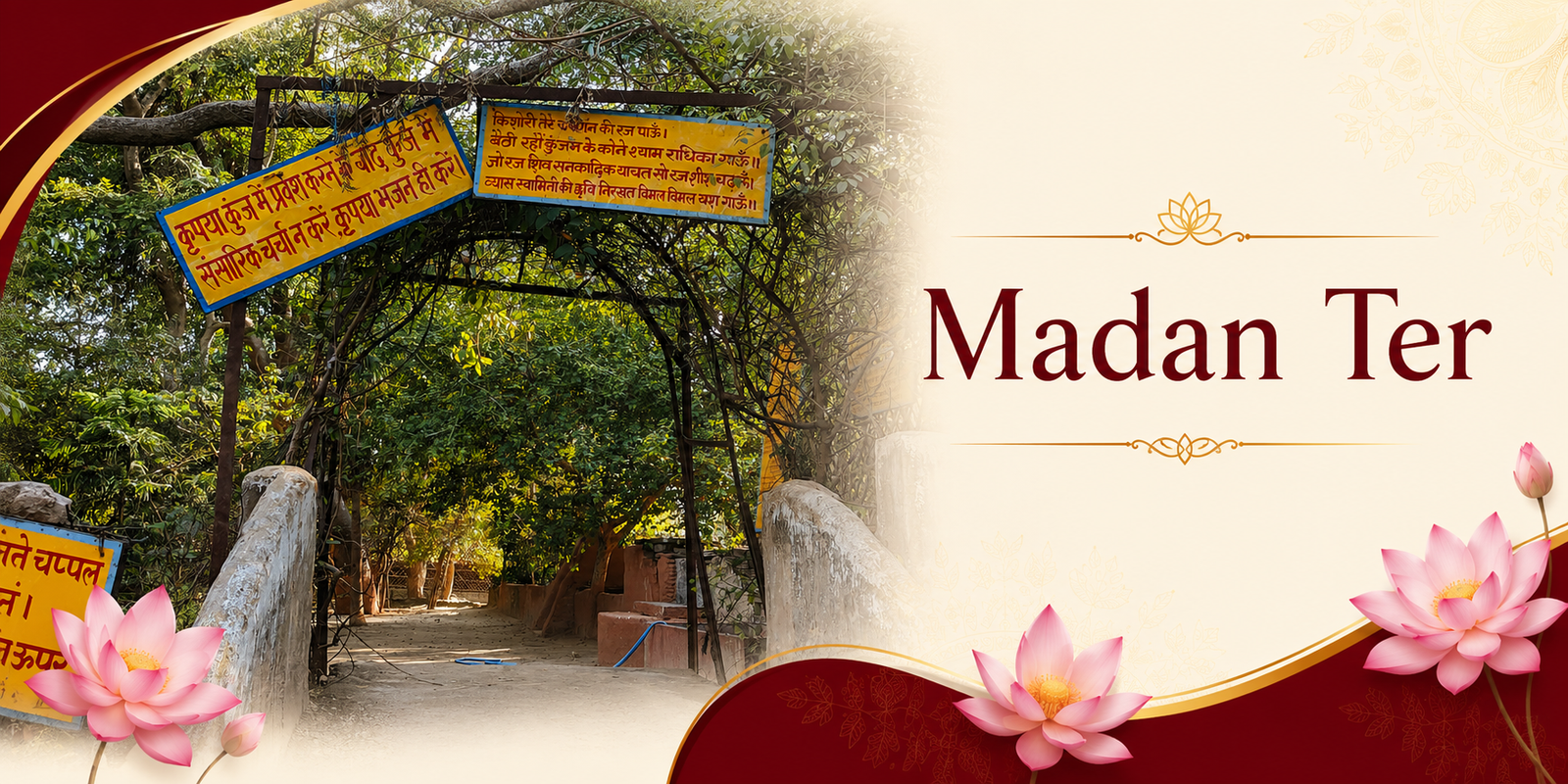
The First Lata Mandir of Shri Radhavallabh Lal
हित अली प्यारी कुँवरि कौ पुनि पुनि चेत कराये।
मदन टेर की ओर चलि काहे देर लगाये॥
hit ali pyaari kunwari kau puni puni chet karaye.
madan ter ki or chali kahe der lagaye.
When Shri Hit Harivansh Mahaprabhu first came to Vrindavan in 1506 from Devband, Vrindavan looked nothing like it does today. Back then, Vrindavan was thick forest — trees and creepers grew so close together that sunlight barely reached the ground. In the middle of this wilderness was a raised mound, close to where the Yamuna flowed. It was called “Unchi Thor,” and the spot itself came to be known as Madan Ter.
It was here, under an old banyan tree, that Mahaprabhu emplaced Shri Radhavallabh Lal for the first time in Vrindavan. He never let anyone build a mandir of stone or brick — only the natural cover of creepers sheltered the Radhavallabh Lal. That’s why this is called the first Lata Mandir, a temple made of living trees and vines, not walls.
This spot was chosen with great care — close to the forest’s own lata, its sacred raj, and the gentle presence of Yamuna ji. Right here, under this banyan tree, Mahaprabhu offered a heartfelt prayer for the wellbeing of all — that no living creature, however small, should ever come to harm in this place, that every being should dwell here in peace and happiness, and that every home and every heart should stay fixed on Shri Radhavallabh Lal. This is beautifully captured in Mahaprabhu’s own words:
सब सौं हित निष्काम मति श्री वृन्दावन विश्राम।
श्री राधावल्लभ लाल को हृदय ध्यान मुख नाम॥
sab sau hit nishkaam mati shree vrindavan vishraam.
shree radhavallabh laal ko hriday dhyaan mukh naam.
And so, by honouring the leaves, the raj (divine soil of Shri Vrindavan), and the sacred presence of Yamuna ji with such love, this place came to life as something far more than a spot in the forest — Madan Ter became a place where feeling, austerity, and spiritual practice all meet as one:
- Bhava Sthali
- Tapo Sthali
- Sadhan Sthali
Where Hit Chaurasi Was Written
Sitting under this same tree, absorbed in seva of his Thakur ji, Mahaprabhu composed most of the Hit Chaurasi — the main text of the Radhavallabh Sampradaya, made up of eighty-four padas. Almost every verse came out of moments spent right here, under these branches. Even today, followers of the Radhavallabh Sampradaya read Hit Chaurasi as their most important scripture.
Shri Narwahan Ji
Shri Narvahan ji was the chief of this region during the time when Vrindavan lay hidden within dense forest. He held sway over the area, collecting toll from merchants travelling the Yamuna trade route and maintaining his stronghold with the help of his men. When Shri Hit Harivansh Mahaprabhu came to reside in Vrindavan, Narvahan grew drawn to him, and coming before him, was overcome with devotion. Mahaprabhu ji blessed him, freed him from his past conduct, and initiated him upon the path of devotion. Narvahan ji then withdrew from worldly affairs and gave himself to seva and upasana.
Pleased with his unwavering guru-devotion, Shri Hit Harivansh Mahaprabhu ji gifted him two of his own compositions from Shri Hit Chaurasi — Pad Sankhya 11 and 12 — a rare instance of a guru offering his own creation to a disciple.
Where Radhavallabh Lal’s Seva Traditions Began
Madan Ter isn’t just where Radhavallabh ji came — it’s also where several traditions of the Radhavallabh Mandir actually started.
It’s said that Shri Hit Harivansh Mahaprabhu ji himself bowed to Yamuna ji, composed and sang the Yamunashtak right here. And this is also where the Ashtayam Seva of Radhavallabh Mandir began — the same seva that continues today, with its seven bhog offerings and five aartis, all tracing back to this spot.
There was never any show of grandeur here. Creatures of every kind moved about together in complete peace, and all around, for as far as one could see, there was nothing but love — the love of Hit ji Maharaj, and the love that filled the air with Shri ji’s own arrival in Vrindavan.
This is what makes Madan Ter different from most other places in Braj.
Most sites in Braj
Connected to Krishna’s Braj Leela.
Madan Ter
Tied to Nikunj Leela — the more intimate, inner devotional leela that Mahaprabhu wrote about in Chaurasi and his other texts. Shri Sevak Vani also speaks of its importance.
लता-भवन सुख शीतल छाहाँ। श्रीहरिवंश रहत नित जहाँ॥
तहाँ न वैभव आन की॥
lata-bhavan sukh sheetal chhahan. shreeharivansh rahat nit jahan.
tahan vaibhav aan ki.
This is also why Mahaprabhu always taught that seva should stay close to nature. In his time, nothing was artificial — flowers were used for shringar, the mandir was made of creepers, and everything that was offered to Shri Radhavallabh Lal came from mother nature. He never had a built mandir constructed in his lifetime.
Even animals that are natural enemies — predators and their prey — are said to have stayed together peacefully here in Mahaprabhu’s presence. The atmosphere was so full of love that their violent instincts simply melted away.
The Sacred Land Around Madan Ter
Even the land around Madan Ter carries its own story. Before Mahaprabhu arrived in Vrindavan, a villager from his native village gave him a single arrow, promising that all the land the arrow crossed — from the high mound where it was released to the spot where it finally landed — would belong to Shri ji.
From Unchi Thor, the arrow was shot, and it came down near Govind Ghat. Because of this, that place came to be known as Teer Ghat, the “Ghat of the Arrow.” Over time, as the name softened and changed in everyday speech, it became known as Cheer Ghat, the name it still carries today.
Close to Cheer Ghat lies Ras Mandal. In this way, two sacred places stand at either end of this land — Unchi Thor on one side and Ras Mandal on the other — with Seva Kunj resting quietly between them.
लता-लता सब कल्पतरु, पारिजात सब फूल।
सहज एक रस रहत हैं, झलकत यमुना कूल॥
lata-lata sab kalpataru, paarijaat sab phool.
sahaj ek ras rahat hain, jhalakat yamuna kool.
What You Can See Today
Even now, five hundred years later, Madan Ter looks much the same — the same banyan tree, the same quiet ground. You can still see the footprints of Radha and Krishna preserved here. The place sits along the Vrindavan Parikrama Marg, within the area near to Shri Radhavallabh Mandir.
Nitya Bihar still happens here — it never stopped, and it continues even now. Every year, the day the Ashtayam Seva began is celebrated as ‘Pat Mahotsav’ — the day Mahaprabhu started the tradition of the seven bhog and five aarti seva that’s still followed at Radhavallabh Mandir today.
This same spirit of love continues at Madan Ter to this day. Every year, during festivals, the beautiful tradition of building sacred kunj is carried on, along with special seva arrangements:
- Chandan Kunj
- Usir Kunj
- Jhulan
- Hori
- Dhol
- Phool Bangla
Alongside this, the old tradition of protecting the forest’s trees and creepers is still kept alive, carried forward today through efforts like the Vriksharopan Sankalp and the Shri Vrindavan Sanrakshan initiative by Shri Hit Mohit Maral Goswami ji Maharaj (Shri Hit Tilkayat Adhikari Ji).
Madan Ter is also where several important compositions of the Sampradaya came to be written, including Shri Chaurasi ji and the padas of Shri Sphut Vani, alongside the Yamunashtak. And portraits of all the acharyas of the Sampradaya are lovingly enshrined here too, as part of the sakhi-sahachari mandal seva.
The atmosphere here is very peaceful. People say if you sit here even for a few minutes, you lose track of time. Birds sing all around, and it almost feels like every leaf and creeper is whispering “Radha, Radha.” Devotees still sit under these trees to read Hit Chaurasi and chant the names of Radha and Krishna.
आजु प्रभात लता-मंदिर में,
सुख बरसत अति हरषि युगल वर।
गौर श्याम अभिराम रंगभरे,
लटकि-लटकि पग धरत अवनि पर॥
कुच-कुमकुम रंजित मालावलि,
सुरत नाथ श्रीश्याम धाम धर।
प्रिया प्रेम के अंक अलंकृत,
चित्रित चतुर-शिरोमणि निजकर॥
दम्पति अति अनुराग मुदित कल,
गान करत मन हरत परस्पर।
(जैश्री) हित हरिवंश प्रशंस-परायण,
गायन अलि सुर देत मधुर तर॥
Aaju prabhaat lata-mandir mein,
sukh barasat ati harashi yugal var
Gaur shyaam abhiraam rangabhare,
lataki-lataki pag dharat avani par
Kuch-kumakum ranjit maalaavali,
surat naath shreeshyaam dhaam dhar
Priya prem ke ank alankrt,
chitrit chatur-shiromani nijakar
Dampati ati anuraag mudit kal,
gaan karat man harat paraspar
(Jaishree) Hit Harivansh prashans-paraayan,
gaayan ali sur det madhur tar.